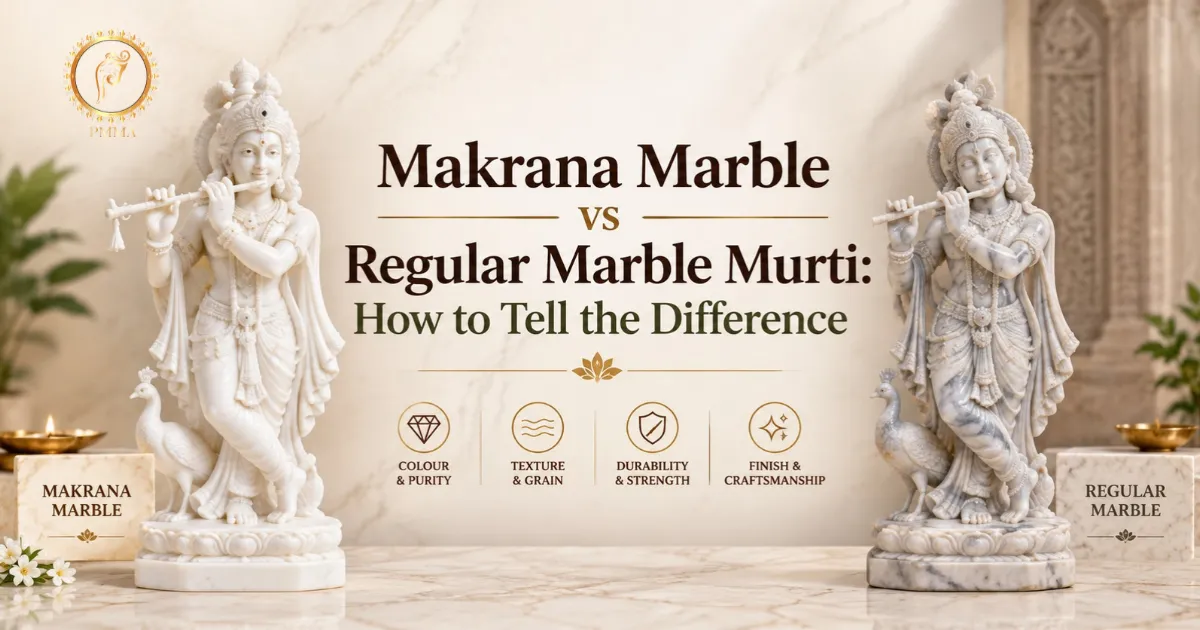
Walk into any marble market in Jaipur and you will hear the same line from almost every shopkeeper: "Sir, yeh pure Makrana hai." Sounds reassuring, but not every stone sold under that name comes from Makrana.
If you are planning to bring a Makrana marble murti home or to your temple, this guide will help you tell genuine stone from a look-alike. No jargon, just what actually works when you are standing in front of a statue with money in your hand.
What Is Makrana Marble, and Why Does It Matter?
Makrana is a small town in Nagaur district, Rajasthan. The quarries here have supplied marble for centuries, and the Taj Mahal is the most famous example of what this stone can do.
Makrana marble is known for three things:
- High purity: It has a very high calcium carbonate content, so the stone looks clean and bright.
- Fine, even grain: Sculptors can carve delicate details like fingers, jewellery and facial expressions without the stone chipping.
- Low porosity: It absorbs less water and stains less than most other marbles.
For a murti, this matters more than it does for a floor tile. A murti is something you worship, touch, bathe and decorate every day. It should last for generations, not just look good on the first day.
What Counts as "Regular Marble"?
This is where people get confused. "Regular marble" is not one thing. In the murti market, it usually means one of these:
- Other Indian white marbles from different quarries. Some are perfectly good stones, just not Makrana.
- Imported white marble (often Italian-looking or Vietnamese stone), which is sometimes passed off as Makrana.
- Marble dust or composite stone, where crushed marble is bound with resin and moulded. It is sometimes called "artificial marble."
- Dyed or polished-up stone that has been treated to look whiter than it really is.
Not all of these are bad. An honest seller will tell you what the stone is and price it accordingly. The problem starts when a cheaper stone is sold at Makrana rates.
7 Simple Ways to Spot a Genuine Makrana Marble Murti
You do not need a lab. These checks work in a shop or workshop, and most of them take under five minutes.
1. Look at the Colour in Natural Light
Do not judge a murti under showroom LED lights. Take it to a doorway or window.
Genuine Makrana has a soft, creamy-white glow, sometimes with faint grey or light veins. Very chalky, snow-white stone with no natural variation should make you a little cautious. Pure stone rarely looks that uniform.
2. Do the Torch Test
Shine your phone torch on a thin or edged part of the murti, like the fingers, ear or the base of a lotus.
Good Makrana lets some light pass through and glows softly from within. Composite or heavily filled stone looks flat and dull under the same light.
3. Feel the Surface Temperature
Place your palm on the murti for a few seconds. Real marble feels cool and smooth, even in summer. Resin-based pieces warm up faster and can feel slightly plasticky.
4. Check the Weight
Natural marble is dense. A murti that feels surprisingly light for its size deserves questions. Ask the seller whether it is solid stone or hollow, and whether it is a single piece or joined.
5. Tap and Listen
Gently tap the murti with a knuckle or a coin. Solid marble gives a clear, slightly ringing sound. A dull, hollow thud can suggest filler, a crack, or a composite.
6. Study the Carving
This is the check that comes with experience. In genuine Makrana work, the details are crisp: eyelids, jewellery, folds of clothing and fingers. Look at the back and the base too. Good workshops finish the parts you do not usually see.
Rough tool marks, soft edges and blurry faces usually mean either a weaker stone or a rushed job.
7. Ask for the Source, and Look at the Paperwork
A trustworthy manufacturer will tell you where the block came from and will be happy to share photos of the workshop or the work in progress. Vague answers are a red flag. Ask for a proper bill mentioning the type of marble.
A small caution: Please avoid scratch tests or acid tests on the actual murti. Marble is soft enough to scratch, and acid will damage the polish permanently. If you really want to test, ask for a small off-cut piece of the same stone.
Makrana vs Regular Marble Murti: Quick Comparison
| Feature | Makrana Marble | Regular / Composite Marble |
|---|---|---|
| Colour | Creamy white, soft glow | Chalky white or dull, sometimes uneven |
| Light passes through | Yes, at thin edges | Little or none |
| Detailing | Sharp and refined | Often soft or blurry |
| Longevity | Decades, even generations | Can stain, yellow or crack sooner |
| Feel | Cool, smooth, dense | May feel warm or light |
| Price | Higher, but reflects the stone | Lower, but often not a bargain |
Why Makrana Marble Is Worth the Extra Money
Yes, a Makrana piece usually costs more. Here is what you actually get for it:
- Durability: It handles daily jal, milk and panchamrit abhishek far better.
- Better detailing: The stone lets sculptors add fine work that cheaper marble cannot hold.
- Lasting shine: With basic care, the surface stays bright for years.
- Traditional value: Many families prefer Makrana for a murti because of its purity and heritage.
- Resale and inheritance value: A well-made stone murti is something you can pass down.
Common Mistakes Buyers Make
I have seen these repeatedly, both from first-time buyers and from people who have bought murtis before:
- Buying on price alone. If the rate is far below the market, ask yourself what has been changed to make it that cheap.
- Trusting the word "Makrana" without proof. Anyone can say it. Few can back it up.
- Judging from photos only. Camera filters and lighting can make any stone look perfect.
- Ignoring the back and base. A well-finished front with a rough back is a warning sign.
- Not asking about polish. Heavy chemical polish can hide weak stone for a while, then fade.
- Forgetting the size and space. Measure your mandir or shelf first, including the height of the pedestal.
Practical Tips Before You Buy
- Visit the workshop if you can. Jaipur's murti-making lanes are famous for a reason. Seeing the carving process tells you a lot.
- Compare two or three pieces side by side in the same light.
- Ask about the carving time. A detailed murti takes days or weeks, not hours.
- Confirm packing and transport. Marble is heavy and breakable. Good sellers pack in wooden crates with cushioning.
- Decide the deity and style first. A calm, well-proportioned face is more important than decoration. If you are still choosing, browsing options like a Ganesh murti or a Radha Krishna marble murti helps you compare finishing and expressions.
Which Murtis Suit Makrana Marble Best?
Makrana works especially well where expression and detailing matter. Popular choices include:
- Ganesh ji: A classic gift for housewarming and shop openings.
- Radha Krishna: Where soft faces and flowing dresses need fine carving.
- Ram Darbar: A multi-figure set where consistency in stone and finish is important.
- Durga Mata and Laxmi ji: Where ornaments and facial detail carry the look.
- Shiv Parvati and Khatu Shyam ji: Popular for both homes and temples.
- Laddu Gopal: Small pieces that are handled and bathed often, so stone quality matters.
If you want a complete prayer corner, a marble temple for home in the same stone keeps the whole setup looking consistent.
How to Care for Your Makrana Marble Murti
Even the best stone needs basic care:
- Wipe with a soft, damp cotton cloth. Dry it afterwards.
- Avoid harsh cleaners, acids, bleach and scrubbing pads.
- Wipe off turmeric, kumkum, sandalwood paste and oil soon after puja, since they can leave marks if left for long.
- Keep it away from constant dampness and direct harsh sunlight.
- Place it on a stable base to avoid accidental falls.
Final Thoughts
Telling Makrana from regular marble is not about becoming a geologist. It is about looking closely, asking the right questions and buying from people who are open about their work. Check the glow, the weight, the detailing and the paperwork, and you will already be ahead of most buyers.
A murti is not just decor. It is something your family will live with, pray to and hopefully hand down. Spend a little extra time now, and it will repay you for decades.
Looking for an authentic Makrana marble murti? Contact our Jaipur workshop team today for photos, sizes, and a custom quote, and see the quality for yourself before you decide.
FAQs
1. How can I check whether a marble murti is real Makrana marble at home?
Use natural light to check the creamy glow, shine a torch on thin edges to see light passing through, feel for cool and smooth texture, and inspect the carving on the back. For confirmation, ask for the seller's bill and quarry source.
2. Is Makrana marble murti more expensive than regular marble?
Usually yes, because the stone is purer, finer-grained and easier to carve in detail. The higher price also reflects longer life and better finish, so it often works out better value over the years.
3. Does Makrana marble turn yellow over time?
Good marble holds its colour well, but it can develop a slight warm tone with age, oils and moisture. Regular cleaning and keeping off harsh chemicals slows this down. Very fast yellowing can indicate poor stone or a cheap coating.
4. Can I use milk, water and panchamrit for abhishek on a marble murti?
Yes, that is common practice. Just wipe the murti with a soft cloth soon after and avoid letting acidic or sticky mixtures dry on the surface.
5. What is the difference between marble murti and artificial marble murti?
A marble murti is carved from a solid natural stone block. An artificial one is made by moulding marble dust with resin or cement. It can look similar at first, but it usually lacks the natural glow, fine detailing, and long-term durability.