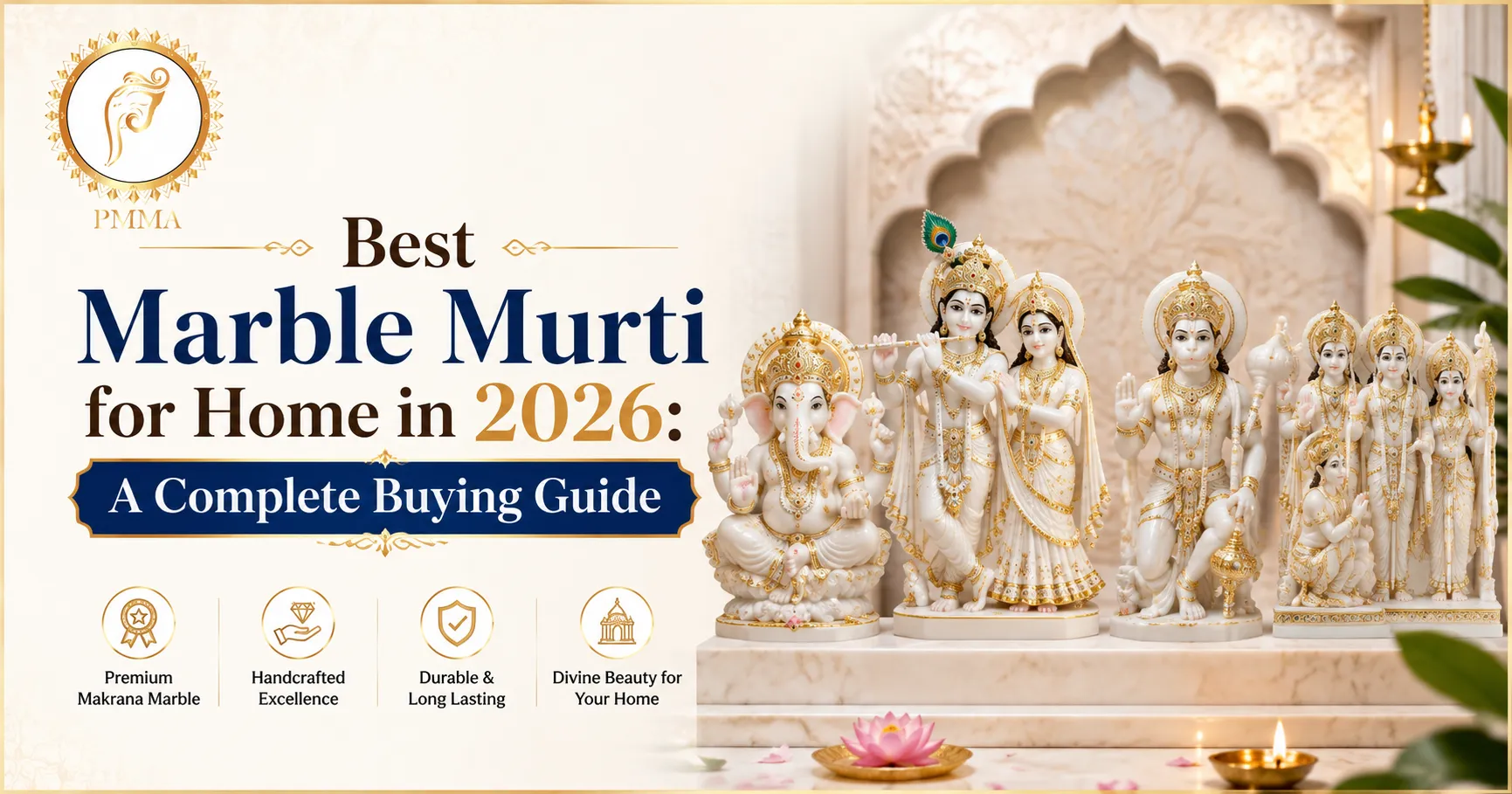
Best Marble Murti for Home in 2026: A Complete Buying Guide
Choosing the right murti for your home temple is never just a shopping decision. It's an emotional one. The deity you bring home becomes part of your everyday life, present during your morning prayers, your festivals, your quiet moments of gratitude, and your toughest days, too.
With 2026 seeing a fresh wave of interest in home mandirs and traditional decor, more and more families are moving away from plastic or plaster-of-Paris idols and choosing marble instead. And honestly, it's not hard to see why. Marble murtis have this timeless, almost luminous quality that other materials simply can't match.
In this guide, I'll walk you through everything worth knowing before you buy a marble murti for your home, which deities are most popular this year, what to look for in quality, common buying mistakes, and a few practical tips from someone who's spent years around this craft.
Why Marble Murtis Are Still the Top Choice in 2026
Marble has been used for idol-making in India for centuries, and it's not just tradition keeping it alive, it's practicality and beauty combined.
Here's what makes marble murtis stand out:
- Durability: A well-crafted marble statue can last generations without losing its shine.
- Natural elegance: The soft, polished texture of marble gives murtis a serene, almost lifelike expression.
- Low maintenance: Unlike metal idols that need regular polishing, marble murtis stay beautiful with minimal upkeep.
- Spiritual significance: Marble has long been considered a pure and sattvic material, ideal for deities.
- Customisation: Skilled artisans can carve intricate details, postures, and expressions that are hard to replicate in other materials.
If you're setting up a marble pooja mandir for home this year, you're really investing in something that's built to be part of your family's story for decades.
Most Popular Marble Murtis for Home in 2026
Let's talk about which deities families are choosing most this year, and why.
Marble Ganesh Statue
Lord Ganesha remains, without question, the most sought-after murti for Indian homes. As the remover of obstacles and the deity of new beginnings, a marble Ganesh murti for home mandir is often the very first idol families install.
What's trending in 2026 is a slight shift toward minimalist Ganesh postures, simpler, cleaner carvings instead of overly ornate ones, though traditional designs with intricate jewellery work are still widely loved.
Marble Radha Krishna Statue
There's something about a white marble Radha Krishna statue that instantly elevates a pooja room. The grace of Radha and Krishna's expressions, captured in cool white marble, brings a calm, devotional energy that's hard to describe until you see it in person.
These murtis are especially popular among younger families setting up their first home temple, often paired with soft yellow or blue accents to highlight Krishna's traditional colours.
Marble Hanuman Statue
For households seeking strength, protection, and courage, a marble Hanuman statue is a common choice. Many families place this murti facing the entrance of the home or near the main door, believing it guards the household from negative energy.
Marble Ram Darbar Murti
A marble Ram Darbar murti, depicting Lord Ram, Sita, Lakshman, and Hanuman together, is a beautiful centrepiece for larger home temples. It represents family harmony, righteousness, and devotion, making it a meaningful choice for joint families.
Marble Saraswati Statue for Home
With education and creativity being a priority for so many households, a marble Saraswati statue for home has seen a noticeable rise in demand, particularly among families with school or college-going children.
Marble Laxmi Idol for Pooja Room
No home temple feels complete without the blessings of wealth and prosperity. A marble Laxmi idol for the pooja room is often installed alongside Ganesha, especially before Diwali, symbolising abundance and good fortune for the year ahead.
What to Look for When You Buy a Marble Murti
Not all marble statues are created equal, and this is where a lot of buyers go wrong. Here's what actually matters:
1. Type of Marble Used
Ask specifically whether the murti is made from genuine Makrana marble. Makrana marble, sourced from Rajasthan, is known for its purity, fine grain, and durability. It's the same marble historically used in monuments like the Taj Mahal, which tells you something about its quality.
2. Finish and Detailing
Run your eyes (and if possible, your hand) over the murti's finishing. Look for smooth polishing, clean facial features, and well-defined carving in the hands, ornaments, and clothing folds.
3. Symmetry and Proportion
A well-made murti should look balanced from every angle. Slight asymmetry in the eyes or posture is a common sign of rushed or lower-quality work.
4. Colour Consistency
Genuine marble has a natural, even tone. Be cautious of murtis with patchy or overly bright white colouring, as this can sometimes indicate added coatings rather than natural marble.
5. Artisan Background
Whenever possible, buy from a trusted marble murti manufacturer Jaipur craftsmen are known for, since Jaipur and the surrounding Rajasthan region have generations of inherited sculpting expertise passed down through families.
Common Mistakes to Avoid While Buying a Marble Murti
- Buying based on price alone: A noticeably cheap marble statue often means compromised material or rushed craftsmanship.
- Skipping measurements: Always measure your mandir space before ordering; an oversized murti can overwhelm a small home temple.
- Ignoring the seller's reputation: Whether you're buying in-store or planning to buy a marble statue online, India-wide, always check reviews and ask for actual product photos.
- Not asking about transportation and installation: Marble murtis are heavy and need careful handling; confirm this with your seller beforehand.
- Overlooking the murti's expression: Spend a few extra minutes looking at the face, the eyes and expression matter more than people expect, since this is what you'll connect with daily.
Tips for Choosing the Right Marble Temple for Home
- Measure your available space and decide on a single large murti versus a few smaller ones.
- Consider the natural lighting in your mandir area; marble looks stunning under warm, soft lighting.
- If you're buying a marble temple for home as a complete unit, check whether it includes a designated platform for the murti.
- Match the murti's size and design with the scale of your home. A grand Ram Darbar suits larger spaces, while a single Ganesh or Krishna murti works beautifully in compact apartments.
- Don't hesitate to ask the manufacturer about the sourcing and authenticity of the marble used.
Benefits of Choosing a Trusted Marble Murti Shop
Buying from an experienced, reputed marble murti shop Jaipur families have relied on for years comes with real advantages:
- Assurance of genuine, high-grade marble.
- Access to skilled artisans who understand traditional iconography and proportions.
- Better after-sales support, including guidance on installation and care.
- Customisation options for size, posture, and finer details.
- A more transparent buying experience, whether in person or online.
Why Jaipur Remains the Heart of Marble Murti Craftsmanship
If you've ever wondered why so many families specifically search for a marble murti manufacturer based in Jaipur, it comes down to legacy. Jaipur sits close to the Makrana marble quarries and has been a hub of stone sculpting for generations. The artisans here don't just carve statues; they carry forward techniques passed down through their families, often refined over decades of dedicated craftsmanship.
This deep-rooted expertise is exactly why so many devotees, even those living abroad, prefer to buy a marble statue online India-wide from Jaipur-based manufacturers rather than settling for mass-produced alternatives.
Final Thoughts
Choosing the best marble murti for your home in 2026 isn't just about following trends, it's about finding a piece that resonates with your family's faith, fits your space beautifully, and is crafted with genuine skill and devotion.
Take your time. Compare designs, ask questions about the marble and craftsmanship, and trust your instinct when you find a murti whose expression simply feels right.
If you're looking to purchase a finely handcrafted marble moorti, whether it's Ganesha, Radha Krishna, Hanuman, Ram Darbar, Saraswati, or Laxmi, do contact us at Pandit Marble Moorti Arts. As an experienced marble murti shop in Jaipur, we specialise in authentic Makrana marble craftsmanship for home temples across India.
Frequently Asked Questions (FAQs)
1. Which marble murti is best for a small home mandir?
For compact spaces, a single, moderately sized marble Ganesh statue or a marble Radha Krishna statue works beautifully, as they offer spiritual significance without overwhelming the available space.
2. How can I tell if a marble murti is made from genuine Makrana marble?
Genuine Makrana marble typically has a fine, even grain, a soft natural sheen, and consistent colouring without patchiness. Buying from an established manufacturer also helps ensure authenticity.
3. Is it safe to buy a marble statue online in India?
Yes, as long as you buy from a reputable seller who provides clear product photos, proper packaging, and transparent information about the marble type and dimensions used.
4. What is the ideal size for a marble murti in a home temple?
This depends entirely on your mandir space, but generally, murtis between 12 and 24 inches work well for most home temples, while larger statues suit bigger dedicated puja rooms.
5. How do I maintain a marble murti at home?
Regular dusting with a soft, dry cloth and occasional cleaning with plain water is usually enough. Avoid harsh chemicals, as they can affect the natural finish of the marble over time.
Pran Pratishtha of Marble Murti at Home: A Complete Step-by-Step Vidhi
If you have recently brought home a beautiful marble murti, or you're planning to, there's one question that almost every devotee asks at some point: how to do pran pratishtha of a marble murti at home the right way?
I get this question a lot, and honestly, it's one of the most important ones. A murti, no matter how exquisitely carved, is just a beautiful sculpture until pran pratishtha is performed. It is this sacred ritual that transforms a marble statue into a living embodiment of the divine, ready to receive your prayers and bless your home.
In this guide, I'll walk you through everything you need to know about marble murti pran pratishtha vidhi at home, from the meaning behind the ritual to the exact steps, common mistakes to avoid, and a few practical tips that make the whole process smoother.
What is Pran Pratishtha? Understanding the Meaning First
Pran Pratishtha literally translates to "establishing the life force." It is a Vedic ceremony in which a murti is consecrated through specific mantras, rituals, and offerings, inviting the deity's divine energy to reside within the idol.
Before this ceremony, a marble murti, however finely sculpted by skilled artisans, is considered merely a representation. Once pran pratishtha is performed, Hindus believe the murti becomes a living form of the deity, deserving of daily worship, respect, and devotion.
This is why, when you buy a marble idol, the work doesn't end at installation. The pran pratishtha ceremony is what truly completes the journey from stone to sacred.
Why Pran Pratishtha at Home Matters
A lot of families today are setting up home temples and choosing marble murtis over other materials because of their durability, elegance, and timeless beauty. But many overlook the importance of performing pran pratishtha correctly.
Here's why it matters:
- It spiritually activates the murti, making your worship more meaningful.
- It is believed to bring positive energy, peace, and prosperity into the household.
- It follows centuries-old Vedic tradition, connecting your home to a larger cultural and spiritual lineage.
- It sets the right intention and sanctity for your home temple from day one.
Skipping this step, or doing it casually, is one of the biggest regrets devotees mention later. So even if your schedule is tight, it's worth doing this properly.
Things You Need Before Starting the Pran Pratishtha Vidhi
Preparation is half the ritual. Before the actual ceremony, gather the following:
- The marble murti, cleaned and free from any dust or packaging residue.
- A small platform or asana, ideally made of wood, to place the murti.
- Gangajal (holy water) or clean water mixed with a few drops of Ganga water.
- Panchamrit (a mix of milk, curd, honey, ghee, and sugar).
- Fresh flowers, garlands, and bilva or tulsi leaves, depending on the deity.
- Incense sticks, a diya, and camphor.
- Vermillion (kumkum), turmeric, and akshat (unbroken rice).
- A new piece of cloth to wrap or seat the murti.
- Fruits and sweets as bhog.
- A priest (pandit) experienced in Vedic rituals, if you want the ceremony done traditionally.
Having everything ready beforehand keeps the ritual calm and unhurried, which matters more than people realise.
Step-by-Step Pran Pratishtha Vidhi for Marble Murti at Home
Let's get into the actual process. While regional practices can vary slightly, here is the general sequence followed across most Hindu households.
Step 1: Choose an Auspicious Date and Time
Consult a priest or a panchang to select a shubh muhurat for the ceremony. Pran pratishtha is typically avoided during inauspicious periods like Rahu Kaal, and festivals or specific tithis are often preferred.
Step 2: Clean the Space and the Murti
Before anything else, thoroughly clean the area where the murti will be placed. The murti itself should be gently washed with clean water, and in many traditions, with milk and Gangajal as well.
Step 3: Perform Shuddhikaran (Purification)
This involves purifying the murti and the surroundings using mantras and sprinkling of holy water. The priest usually chants specific shlokas to remove any negative energy from the space.
Step 4: Netra Unmeelan (Opening of the Eyes)
One of the most symbolic parts of the ceremony, this step involves "opening the eyes" of the deity, often done by gently touching the eyes of the murti with a gold needle or applying kajal, accompanied by mantras. This signifies the deity becoming aware and alive.
Step 5: Prana Pratishtha Mantra Recitation
The priest recites specific Vedic mantras, invoking the deity's spirit into the murti. This is considered the core of the entire ceremony, where the divine energy is believed to enter the idol.
Step 6: Abhishekam (Ritual Bath)
The murti is bathed using panchamrit, followed by clean water, then dressed and decorated with new clothes, jewellery, and a garland.
Step 7: Offering Prayers and Bhog
Once dressed, the murti is offered flowers, kumkum, incense, a lit diya, and bhog (fruits and sweets). Aarti is performed, marking the formal beginning of the murti's life in your home temple.
Step 8: Sankalp (Resolution)
The family takes a sankalp, a verbal commitment expressing devotion and the intention behind installing the murti, often including the names of family members for blessings.
This entire ritual can take anywhere between 1 to 3 hours, depending on the deity and the scale of the ceremony.
Tips to Make the Pran Pratishtha Ceremony More Meaningful
- Try to involve the whole family, especially children; it builds a connection with tradition early on.
- Keep your home and the puja space clean and decluttered a day before the ceremony.
- Avoid rushing through the mantras; let the priest take the time required.
- Light natural diyas instead of electric ones for a more traditional feel.
- Play soft devotional music in the background to create a peaceful atmosphere.
- Maintain personal cleanliness (snan) before the ceremony begins.
Common Mistakes to Avoid During Marble Murti Pran Pratishtha
Even well-intentioned families sometimes make small errors that affect the sanctity of the ritual. Here are a few to watch out for:
- Skipping the priest entirely: While some steps can be done independently, the core mantras require a qualified priest for authenticity.
- Using a damaged or chipped murti: Always inspect your marble idol carefully before the ceremony; minor cracks or chips are considered inauspicious.
- Placing the murti in the wrong direction: Vastu plays a role here, most deities are placed facing east or north.
- Rushing the ceremony: This is not a five-minute task; treat it with the patience it deserves.
- Neglecting daily worship afterward: Pran pratishtha is just the beginning; regular puja keeps the energy of the home temple alive.
Benefits of Performing Pran Pratishtha Correctly
When done with sincerity and the right vidhi, families often report:
- A greater sense of peace and positivity at home.
- Stronger spiritual discipline, especially with daily aarti and prayers.
- A deeper emotional and cultural connection across generations.
- A beautifully consecrated home temple that becomes the heart of the household.
It's less about ritual perfection and more about devotion, patience, and intent, the rest follows naturally.
Why the Quality of Your Marble Murti Matters Just as Much
Here's something worth thinking about before the ceremony even begins: the murti itself. A pran pratishtha ceremony deserves a murti that's crafted with skill, fine detailing, and pure, high-quality marble, not just any statue.
This is where artisanship truly matters. A well-sculpted murti, made by experienced craftsmen using authentic Makrana or Rajasthan marble, doesn't just look beautiful; it carries a certain grace and finish that elevate the entire worship experience.
If you're looking for a finely crafted marble murti for your home temple, whether it's Krishna, Ganesha, Shiv Parivar, Durga Maa, or any other deity, Pandit Marble Moorti Arts specialises in handcrafted marble idols made with traditional techniques and genuine craftsmanship. Each murti is sculpted with care, ensuring it's worthy of the sacred pran pratishtha ceremony you're planning.
Final Thoughts
Performing pran pratishtha of a marble murti at home is a deeply personal and spiritual milestone for any family. It's not just a ritual; it's the moment a piece of art transforms into a presence you'll pray to, lean on, and feel comforted by, every single day.
Take your time with it. Involve your family. Follow the steps with sincerity, and don't hesitate to consult a knowledgeable priest if you're unsure about any part of the vidhi.
And if you haven't found the right murti yet, that's the first step worth getting right.
Looking to purchase a high-quality, handcrafted marble moorti for your home temple? Contact Pandit Marble Moorti Arts today, and let us help you bring home a murti that's as sacred as it is beautiful.
Frequently Asked Questions (FAQs)
1. Can pran pratishtha of a marble murti be done without a priest?
While some basic rituals like cleaning and offering prayers can be done by the family, the core pran pratishtha mantras are best performed by a qualified priest, since they require precise Vedic recitation and procedure.
2. How long does the pran pratishtha ceremony usually take?
Depending on the deity and the scale of the ritual, it can take anywhere from one to three hours. It's best not to rush the process.
3. Is there a specific direction the marble murti should face after pran pratishtha?
Yes, in most Vastu traditions, deities are placed facing east or north, though this can vary slightly depending on the specific deity and regional customs.
4. What should be done if the marble murti gets accidentally chipped after pran pratishtha?
A minor chip doesn't necessarily mean the murti needs replacing, but it's best to consult a priest for guidance, as significant damage is traditionally considered inauspicious and may require remedial rituals.
5. Can pran pratishtha be performed on any day, or does it need a specific muhurat?
It's generally recommended to perform pran pratishtha on an auspicious date and time, ideally selected with the help of a priest or panchang, avoiding inauspicious periods like Rahu Kaal.